

👨🏻💼💬📈 Expected Clichés, Matchweeks 5-8
Must-win games already? Farke finds form. Postecoglou's final "mate".

This article is part of the Expected Clichés series, where I’ll be statistically analysing the use of classic British football phrases in Premier League managers’ press conferences during the 2025/26 season.
If you’re wondering why this exists, start with my post: “Introducing: Expected Clichés”, where I explain the project a bit more. You can also explore all of the data for yourself at: expectedcliches.com.
Overview: Must-win games, already?
When does a football match become a “must-win”?
Apparently, this season, you can be a newly promoted side — performing above expectations, playing decent football, and sitting mid-table — and still be asked the question just seven games into the campaign. That was the fate of Régis Le Bris last week, when he was quizzed about the “must-win” nature of Sunderland’s upcoming home fixture against winless Wolves.
Last season, “must-win game” appeared only four times across all press conferences in my dataset. This season it’s already up to six, after only eight rounds of fixtures.
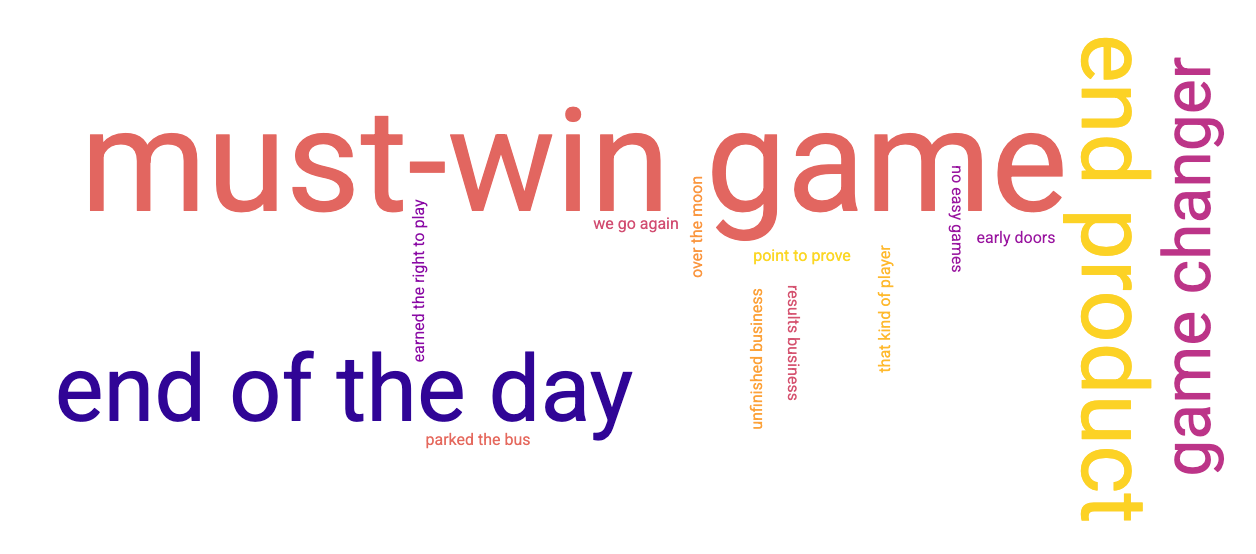
Last season was also much less urgent regarding how soon in the season the phrase appeared. It didn’t get its first mention until February, when Enzo Maresca was asked whether Chelsea had to beat Southampton. In this setting, “must-win game” feels completely devoid of meaning. Plenty of football clichés are actually quite poetic, neatly encoding football stories and emotions into a few short words. “Must-win game” is not one of them.
Without context, it leaves far too much to the imagination: what happens if that must-win game is lost? Does the club dissolve? Does the manager have to enter a witness protection scheme? (Admittedly plausible if your boss is Marinakis.)
Other uses, although somewhat more justified, still feel pointless. On 16th May 2025, with Fulham sitting 11th after 36 games, needing two wins (and a complex combination of results elsewhere) to sneak into Europe, a journalist said: “In the race for Europe now, this is a must-win game, isn’t it?”
Factually correct, yes. Useful? Not really. This is a question better suited to a calculator than a football manager. There are only so many ways Marco Silva can politely restate “yes, we’d prefer to win”.
And it seems I’m not the only one getting disproportionately irritated by this. After thorough VAR review of the six mentions this season, I discovered that four of them occurred in Daniel Farke’s pre-Burnley press conference. After being asked whether it was a must-win game, Farke proceeded to repeat the phrase in increasingly exasperated fashion three times during a 30-second outburst. See for yourself.
Still, even this recent “must-win” pandemic hasn’t been enough to dethrone the current cliché champion. “At the end of the day” remains top of the table with 10 mentions, up from six after the opening four rounds.
“Point to prove” has also fallen off slightly after a strong start, just one appearance this time around, from a journalist asking Farke (again) about Joe Rodon.
Rankings: Farke me
It might seem like Daniel Farke has already received a lot of attention here, but it’s for good reason.
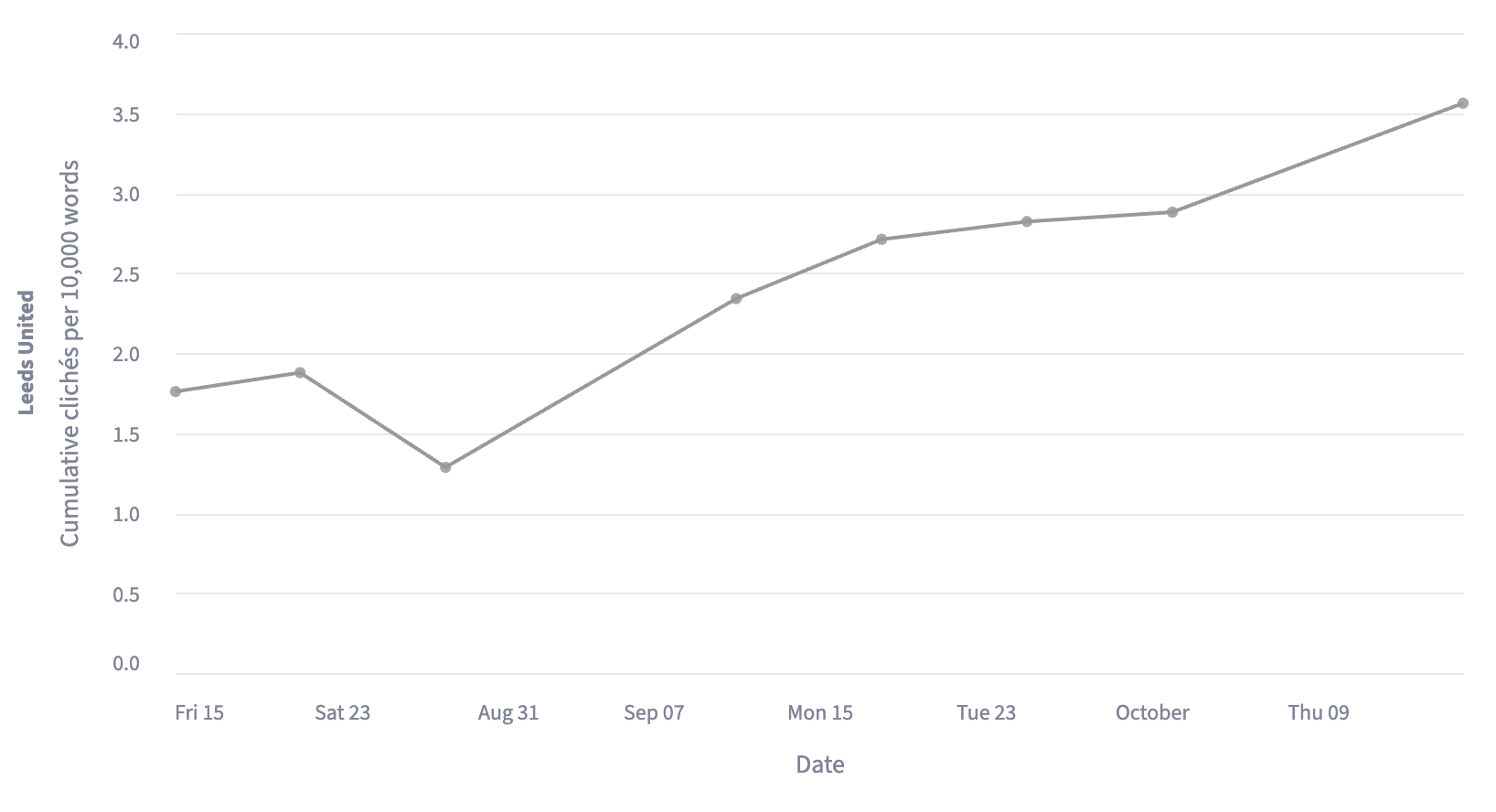
A solid 2.34 clichés per 10,000 words (C/10k) saw his Leeds side sitting sixth after four games. Four press conferences, 12 clichés and roughly 26,000 words later, he’s stormed into top spot with a staggering 3.56 C/10k.
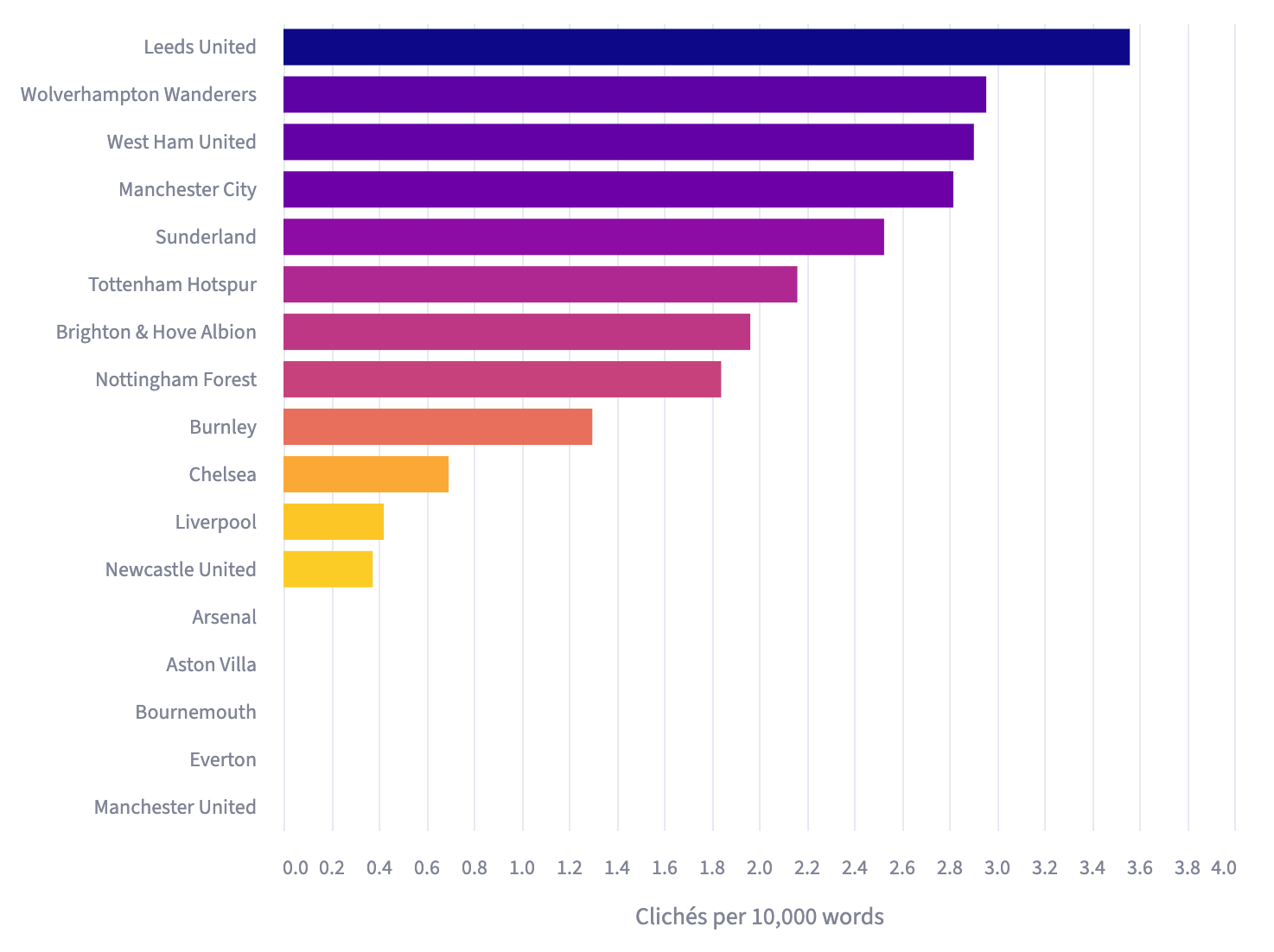
Given that he’s a non-native speaker, I find it genuinely touching to see him rattle off classic British clichés in such metronomic fashion. Unlike most other managers who seem to go through short bursts of rattling off clichés for a bit, Farke has shown steady week-on-week growth. Leeds, therefore have got to be strong favourites to claim the Cliché Title this season, provided Farke keeps his job long enough.
Here’s a compilation of his clichés so far (excluding the “must-win” instances shown earlier).
Highlights: Amorim’s system, and a tribute to Ange
While these articles are dedicated to pure clichés, I wanted to end with two phrases that don’t quite fit that category — but have become just as telling. Some expressions maybe aren’t clichés in the traditional sense; but they’re recurring clues to how a manager thinks, deflects, or defends.
Given that my code can dig up any phrase across the transcripts, I thought I’d use this edition’s highlights section to spotlight a couple of managers who’ve dominated the press over the past four matchweeks.
First up is Ruben Amorim. His steadfast refusal to abandon his beloved three-at-the-back system has become a journalistic obsession. It pains me to admit it (especially after that win at Anfield on Sunday) but perhaps his stubbornness is finally starting to pay off.
Since arriving at Manchester United last season, the “system” has been mentioned 29 times in pre-match press conferences alone. Here’s a compilation of (most of) those references.
Then there’s Ange. His approach to press conferences is, in its own way, just as systematic — a consistent pattern of deflection, gentle humour, and the word mate.
During his short-lived stint at Nottingham Forest, which sadly came to an end on Saturday, he managed seven “mate”s across pre-match press conferences. Six of them came in the cheerful optimism of his unveiling; the seventh arrived weeks later, a lone, weary “mate” in his final press conference on Friday.
Because of this, I’ve chosen to end with a small tribute to Ange’s time at Forest. You’ll be missed, mate.